
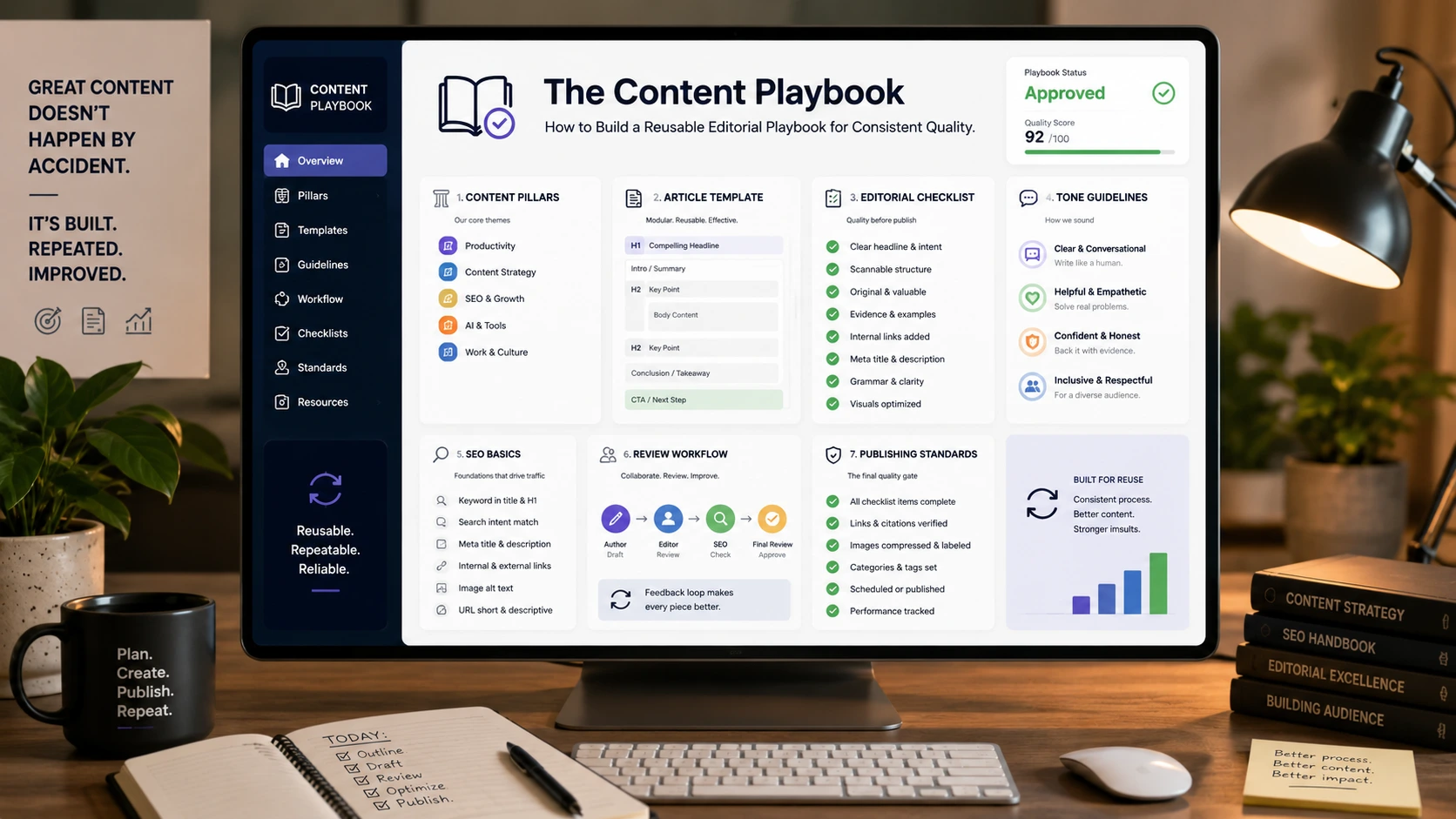
Producing consistent, high-quality content at scale is hard unless teams share the same rules, templates, and expectations. An editorial playbook — a living library of editorial guidelines, reusable templates, and quality checklists — gives writers, editors, and producers a single source of truth. This article walks through a practical, step-by-step approach to design a reusable editorial playbook that speeds production, reduces rework, and raises content quality across your organization.
Why an editorial playbook matters
Without a playbook, each author recreates decisions about tone, structure, keywords, links, and formatting. That leads to unpredictable quality, inefficiency, and extra review cycles. A good playbook:
- Standardizes outputs so readers get the same experience across channels.
- Reduces onboarding time for new contributors.
- Speeds production by providing ready-to-use templates and checklists.
- Makes quality measurable and repeatable with defined acceptance criteria.
Core components of a reusable content playbook
Design your editorial playbook as a small set of high-value artifacts rather than a monolithic manual. The essential components are:
- Editorial guidelines — audience definitions, tone & voice, brand dos and don’ts.
- Style guide template — spelling, capitalization, punctuation, citation style, and preferred terminology.
- Content templates — structural templates for common content types (blog posts, product pages, white papers, how-to guides).
- Content quality checklist — a short, actionable QA checklist for editors to use before publishing.
- Workflow & roles — who does what, approval gates, and SLA expectations.
- Accessibility & legal rules — basic accessibility checks, copyright, and compliance notes.
- Metrics & escalation — how quality is measured and when issues get escalated to stakeholders.
Step-by-step: Build the playbook
Follow these practical steps to go from zero to a reusable playbook your team will actually use.
1. Audit existing content and workflows
Gather representative content and interview contributors. Identify recurring formats, common errors, frequent review comments, and the most time-consuming tasks. Use the audit to prioritize the templates and rules that will deliver the biggest time savings.
2. Define audience, goals, and SLAs
Clarify primary audiences (e.g., prospects, customers, developers), content goals (traffic, conversion, retention, support load reduction), and production SLAs (draft-to-publish timelines, review turnaround).
3. Create style and editorial guidelines
Write concise rules that answer the everyday questions a writer will encounter. Keep this short—2–4 pages—and link to longer references as needed. Include:
- Preferred tone and voice examples
- Terminology and product name usage
- Grammar and punctuation preferences
- SEO basics: primary keyword placement, headings, meta-description length
4. Build content templates
Turn common article structures into fillable templates. Each template should include required sections, suggested word counts, and a short purpose statement. Example templates to prioritize:
- How-to / tutorial
- Product feature page
- Thought leadership / opinion piece
- FAQ / support article
# Example (YAML) style of a template definition
name: How-to Guide
purpose: Teach a non-technical user to complete a task
sections:
- title: Intro
required: true
notes: One-paragraph problem statement and outcome
- title: Prerequisites
required: false
- title: Steps
required: true
notes: Numbered steps, each 1–3 sentences
- title: Troubleshooting
required: false
- title: CTA
required: false
5. Create a short content quality checklist
A checklist should be a single-screen tool editors can use before publish. Keep it to 8–12 verifiable items. Typical checklist entries:
- Does the piece match the template for this content type?
- Primary keyword appears in H1 and first 100 words
- Meta title (50–60 chars) and description (120–155 chars) written
- Internal links added to relevant pages
- All images have descriptive alt text and optimized file sizes
- Accessibility check: headings, lists, contrast
- Fact-checks and approvals completed
6. Define routing, roles, and SLAs
Document the publishing workflow: who produces the draft, who edits, who reviews technical accuracy, and who publishes. Attach SLAs to each step (e.g., editor reviews within 48 hours) and include an exception process for urgent content.
Making the playbook reusable and discoverable
Reusability depends on discoverability and modularity. Use these tactics:
- Store the playbook in a single, searchable location (wiki, CMS, or shared drive) with versioning.
- Break the playbook into modular pages: style guide, templates, checklists, workflows.
- Ship small templates first—proven wins encourage adoption.
- Provide a one-page quick reference for new hires.
Tooling and integration tips
Choose tools that match your publishing cadence and team size. Practical integrations:
- Embed templates in your CMS so authors can create from the template directly.
- Use shared docs or a wiki for the living style guide with change logs.
- Integrate the quality checklist with your workflow tool (e.g., checklist items as tasks in the PR or ticket).
- Automate repetitive checks with linters or SEO tools (broken links, image sizes, basic SEO signals).
Governance: keep the playbook current
Plan for ongoing maintenance to prevent rot:
- Assign a playbook owner responsible for updates and onboarding.
- Review the playbook quarterly with representatives from content, SEO, product, and legal.
- Track playbook usage and friction points—update templates that cause repeated review comments.
Make the playbook small, practical, and easy to change. Teams will follow what they can remember and trust, not what is exhaustive.
Measurement: how to know it’s working
Measure adoption and quality with a mix of usage and outcome metrics:
- Adoption: percent of published items created from templates, checklist completion rate.
- Efficiency: average time from draft to publish, number of review cycles per article.
- Quality outcomes: organic traffic, bounce/engagement, support ticket reduction for help content.
- Qualitative: editor satisfaction and onboarding time for new writers.
Example scenario: launching a how-to content program
Illustrative sequence for a small team (3 writers, 1 editor):
- Week 1: Audit existing help articles and identify the 10 highest-impact how-to topics.
- Week 2: Create a one-page editorial guideline and one how-to template in the CMS.
- Week 3–4: Writers produce drafts using the template; editor uses the quality checklist before publish.
- Month 2: Measure time-to-publish and user satisfaction; iterate on the template and checklist.
Quick-play resources and links
Start small and expand. Useful next steps:
- Link to a deeper playbook example — see our companion playbook for operational structure patterns.
- For template design patterns and long-form guidelines, review our guide on structuring complex content (useful for e-commerce or reference-heavy topics).
- See knowledge-base notes on deploying reusable content and tools in team workflows: how.
Conclusion: iterate toward a living playbook
An editorial playbook is not a one-time deliverable—it's a living toolkit. Prioritize the highest-impact templates and a short quality checklist first. Measure adoption, collect feedback from editors and writers, and update the playbook on a predictable cadence. Over time, a compact, well-used playbook will reduce friction, improve consistency, and let your team publish better content faster.
Frequently Asked Questions
What is an editorial playbook and how is it different from a style guide?
An editorial playbook is a broader toolkit that includes an editorial guidelines summary, style guide template, content templates, workflows, and a content quality checklist. A style guide is typically one component focused on grammar, punctuation, and terminology. The playbook combines style with process and templates so teams can produce consistent work quickly.
How long should my content quality checklist be?
Aim for 8–12 verifiable items that fit on one screen. Keep checklist entries actionable (e.g., "Primary keyword in H1 and first 100 words") so editors can complete the QA quickly and consistently.
Where should the playbook live for best adoption?
Place the playbook in a single, searchable location with version control—your CMS, company wiki, or a shared knowledge workspace. Embed templates in the CMS where authors create content and link the checklist into the publishing workflow for easier use.
How do I measure whether the editorial playbook is effective?
Track adoption (percent of content created from templates), efficiency (time from draft to publish, review cycles), and outcomes (organic traffic, engagement, reduction in support tickets). Also collect qualitative feedback from writers and editors.
How often should we update the playbook?
Review and update the playbook quarterly or whenever a recurring issue emerges. Assign a playbook owner responsible for ongoing maintenance, change logs, and training new team members.