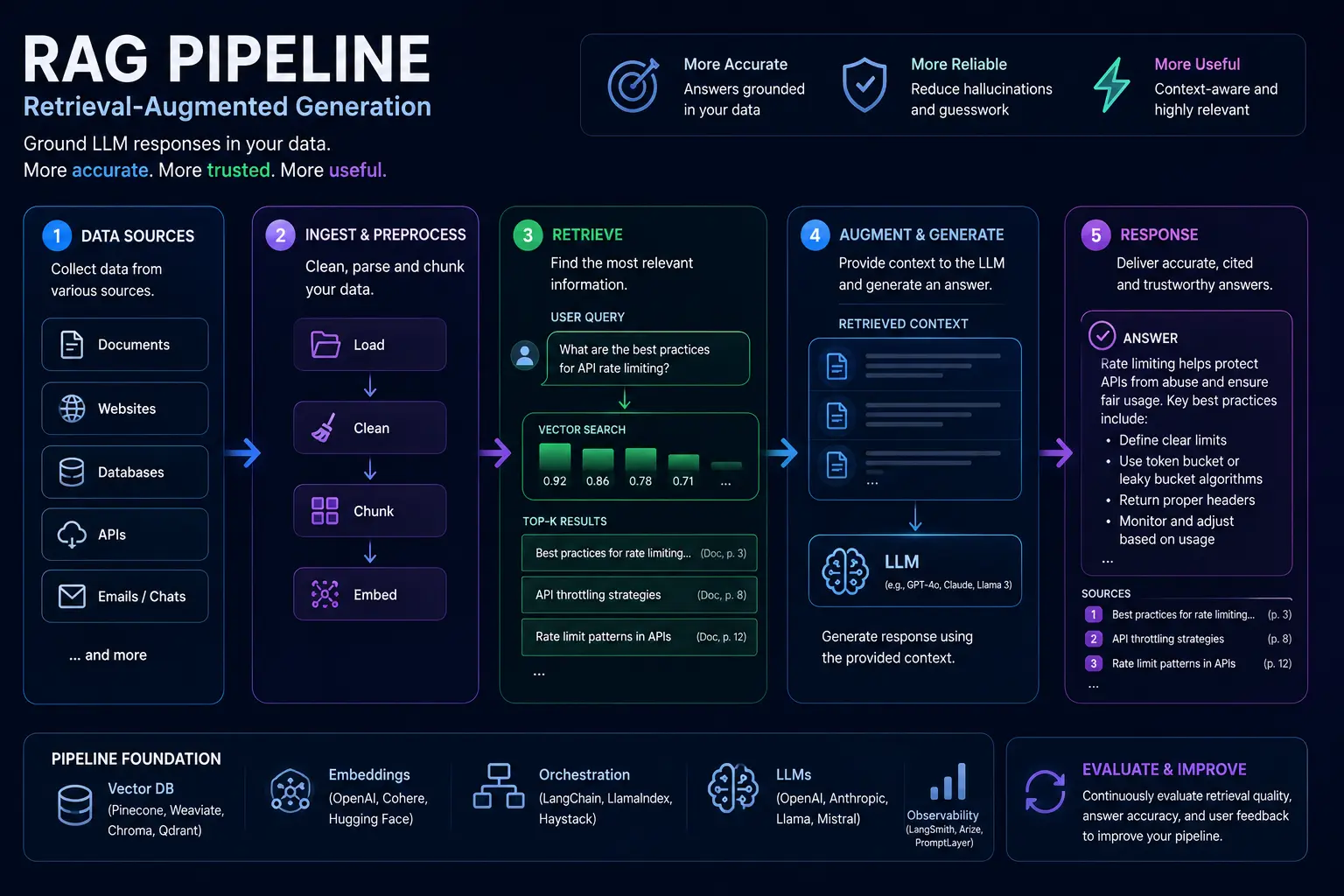
A production-ready RAG pipeline must balance three often-competing requirements: high-quality retrieval, predictable latency, and document freshness. This article focuses on practical decisions you’ll make when designing a RAG pipeline—how to choose and maintain indexes, how to orchestrate retrieval and generation, and how to keep results current without blowing up cost or complexity.
Start with clear design goals and constraints
Before choosing index types or scheduling re-indexing, define the constraints that matter for your product. Typical constraints include:
- Latency budget for a full retrieval+generation call (e.g., 300ms vs 2s).
- Recall and precision targets for retrieval (how tolerant you are of missing a relevant document).
- Freshness window required by users (seconds, minutes, hours, days).
- Operational cost limits (embedding compute, storage, and vector search costs).
- Regulatory or provenance requirements (must cite exact source and timestamp).
Use these to prioritize trade-offs. Tight latency favors compact indexes and caching; strict freshness favors streaming or event-driven updates; high recall favors richer signals (hybrid search, larger context windows).
Indexing strategies: vector, sparse, and hybrid
Choosing the right index mix is one of the most consequential decisions in RAG pipeline design.
Vector indexes (dense retrieval)
Dense vector indexes are central to retrieval augmented generation because they capture semantic similarity. Key considerations:
- Embedding quality: pick models that align with your domain. If you change embedding models, plan for a re-embedding rollout.
- Index type: approximate nearest neighbor structures (HNSW, IVF+PQ) trade accuracy for speed and storage. For low-latency, single-machine HNSW often works well; for very large corpora, consider sharding plus quantization.
- Metadata and IDs: store stable document IDs and minimal metadata alongside vectors so you can fetch authoritative source text at generation time.
Sparse and lexical search
Term-based search (BM25/Elasticsearch/Opensearch) still has value for exact-match signals, date filters, and keyword-heavy queries. Sparse search is inexpensive and deterministic, and it supports boolean and date filters that vector models cannot.
Hybrid search combines strengths
Hybrid search—combining dense vectors with sparse retrieval—gives a practical balance. Use a fast lexical pass to enforce hard filters and a semantic pass for recall. Combining scores or reranking dense candidates with lexical features often improves precision.
Document processing: chunking, metadata, and embeddings
How you segment documents affects retrieval quality and downstream generation.
- Chunk size: pick a chunk length that matches your model’s context needs. Short chunks reduce noise but can fragment context; longer chunks preserve context but increase embedding cost.
- Overlap: modest overlap (10–30%) helps when information spans chunk boundaries, improving recall at a small storage cost.
- Metadata: include timestamps, source type, author, and a stable URL or ID. Use metadata to apply filters and to support provenance in generated answers.
- Canonical text storage: keep canonical source text separately from vectors so you can regenerate snippets or validate answers without re-querying the original source repository.
Freshness strategies and re-indexing policies
Document freshness is often the hardest operational requirement. There are three practical approaches, each with trade-offs:
- Event-driven (near real-time): push updates into the index when content changes. Best for high-value changing content (support docs, financial feeds). Complexity: requires change data capture or webhooks and reliable retry logic.
- Incremental or streaming updates: process a content stream (e.g., Kafka) and apply delta updates—new vectors, re-embeds for modified documents, tombstones for deletes. Balances freshness and operational complexity.
- Scheduled full or partial re-index: run nightly or hourly jobs to rebuild indexes or re-embed changed content. Simpler but introduces a predictable lag and potential compute spikes.
When to re-embed:
- Re-embed immediately if the document content changes in ways that affect meaning or facts.
- Re-embed on embedding model changes—plan a versioned rollout so old and new vectors can coexist during migration.
- Re-embed less-frequently for small cosmetic edits unless freshness SLA demands otherwise.
Practical operational techniques:
- Use tombstones/soft deletes so deleted docs don’t surface while allowing safe reconciliation later.
- Maintain a change log or version number per document and persist it with each vector so you can detect and resolve staleness.
- Track staleness metrics (percentage of queries returning items older than the freshness window) and alert when thresholds break.
Orchestrating retrieval and generation in production
Orchestration is how the system sequences retrieval, reranking, prompt construction, generation, and post-processing. Separate concerns for observability and resilience.
Core orchestration pattern
A reliable pattern is: quick retrieval -> deterministic reranking/filters -> prompt assembly -> model call -> post-checks and provenance. Decoupling these steps gives you places to add caching, fallback paths, and monitoring.
Latency and batching
Design to the tightest end-to-end budget you defined earlier. Common tactics:
- Cache recent retrieval results and generation outputs keyed by query fingerprint and context; cache invalidation must respect freshness policies.
- Use asynchronous background refresh for non-critical UX flows (serve slightly stale result immediately and refresh in background).
- Batch embedding requests where possible during ingestion to reduce cost; avoid batching user-facing calls that add latency.
Reranking and safety checks
After initial retrieval, a lightweight reranker (small transformer or combination of lexical and semantic features) can improve precision before costly LLM calls. Apply safety filters, source checks, and a provenance layer that attaches exact source snippets and timestamps to every generated answer.
Fallbacks and graceful degradation
Build predictable fallbacks: if the vector index is unavailable, fall back to sparse search or a cached answer. If generation fails or exceeds latency budget, return a concise, sourced snippet instead of a hallucinated response.
Operational monitoring, testing, and SLAs
Production RAG systems require a mix of infrastructure and quality metrics:
- Infrastructure metrics: index query latency, embedding job success rate, CPU/memory for index nodes, index size and shard health.
- Quality metrics: retrieval precision/recall on a labelled benchmark, rate of hallucinations (detected via automated fact-checking where possible), and error rate for provenance links.
- Business SLAs: percent of queries under latency target, freshness SLO (e.g., 95% of critical docs re-indexed within 5 minutes), and availability of the retrieval service.
Test with synthetic queries and real user queries held out as a benchmark. Run A/B experiments for major changes (new embedding model, different chunking strategy) and measure both technical metrics and downstream user impact.
Common architecture patterns and when to use them
Three repeatable patterns work for most teams:
- Simple monolith: single service handles ingestion, indexing, and retrieval. Good for prototypes or small datasets where operational simplicity matters.
- Decoupled microservices: separate ingestion, embedding, index service, and orchestration. Scales better and isolates failures—recommended for production systems with clear SLAs.
- Event-driven streaming: content updates flow through a message bus to update indexes incrementally. Best when freshness and throughput are critical.
Trade-offs: monoliths are cheap to operate but harder to scale; microservices add operational overhead but improve resilience; streaming reduces reindex latency at the cost of pipeline complexity.
Practical checklist for RAG pipeline design
- Define latency, freshness, and quality SLOs before selecting index types.
- Choose a chunking strategy that matches model context windows and apply modest overlap to capture cross-boundary information.
- Adopt hybrid search where lexical filters or exact matches matter.
- Implement versioned embeddings and a migration plan when updating embedding models.
- Prefer event-driven or incremental re-indexing for high-freshness needs; schedule full re-indexes for bulk changes or reconciliation.
- Decouple retrieval and generation with clear interfaces, and add lightweight reranking before expensive model calls.
- Instrument both infra and quality metrics; create synthetic query suites for regression testing.
- Add sensible fallbacks (lexical search, cache, concise sourced snippets) to avoid hallucinations under failure.
Build the pipeline to your constraints: there is no single best RAG pipeline design—there are designs that match your latency, cost, and freshness goals.
If you want a practical starting point, combine a compact HNSW-style vector index for semantic recall, a BM25 lexical layer for filters and exact matches, an incremental ingestion stream for content changes, and a small reranker before LLM calls. That composition handles most production needs with a manageable operational footprint.
Next steps to implement
Pick one measurable improvement to implement first—reduce tail latency, lower reindex lag for a high-value content set, or add provenance to the top N generated answers—and iterate. Small, observable changes compound quickly in production systems.
Frequently Asked Questions
How often should I re-embed documents in a RAG pipeline?
Re-embed when document content meaningfully changes, when you switch embedding models, or according to a freshness SLA. For many systems, a mix of event-driven updates for critical content plus nightly batches for lower-priority content hits a good balance.
When should I use hybrid search instead of only vector search?
Use hybrid search when you need exact-match or filterable signals (dates, booleans), or when lexical cues strongly affect relevance. Hybrid approaches improve precision for queries that rely on keywords or structured metadata.
What are practical fallbacks if the vector index is unavailable?
Fallback options include returning cached retrieval results, using a lexical search layer (BM25), or serving concise sourced snippets. Ensure your fallback respects provenance and clearly indicates any staleness to users.
How do I measure freshness for my RAG pipeline?
Define a freshness window per content class and measure the fraction of queries that surface documents older than that window. Instrument re-index latency, time-since-last-embed per document, and alert on breaches of your freshness SLOs.