
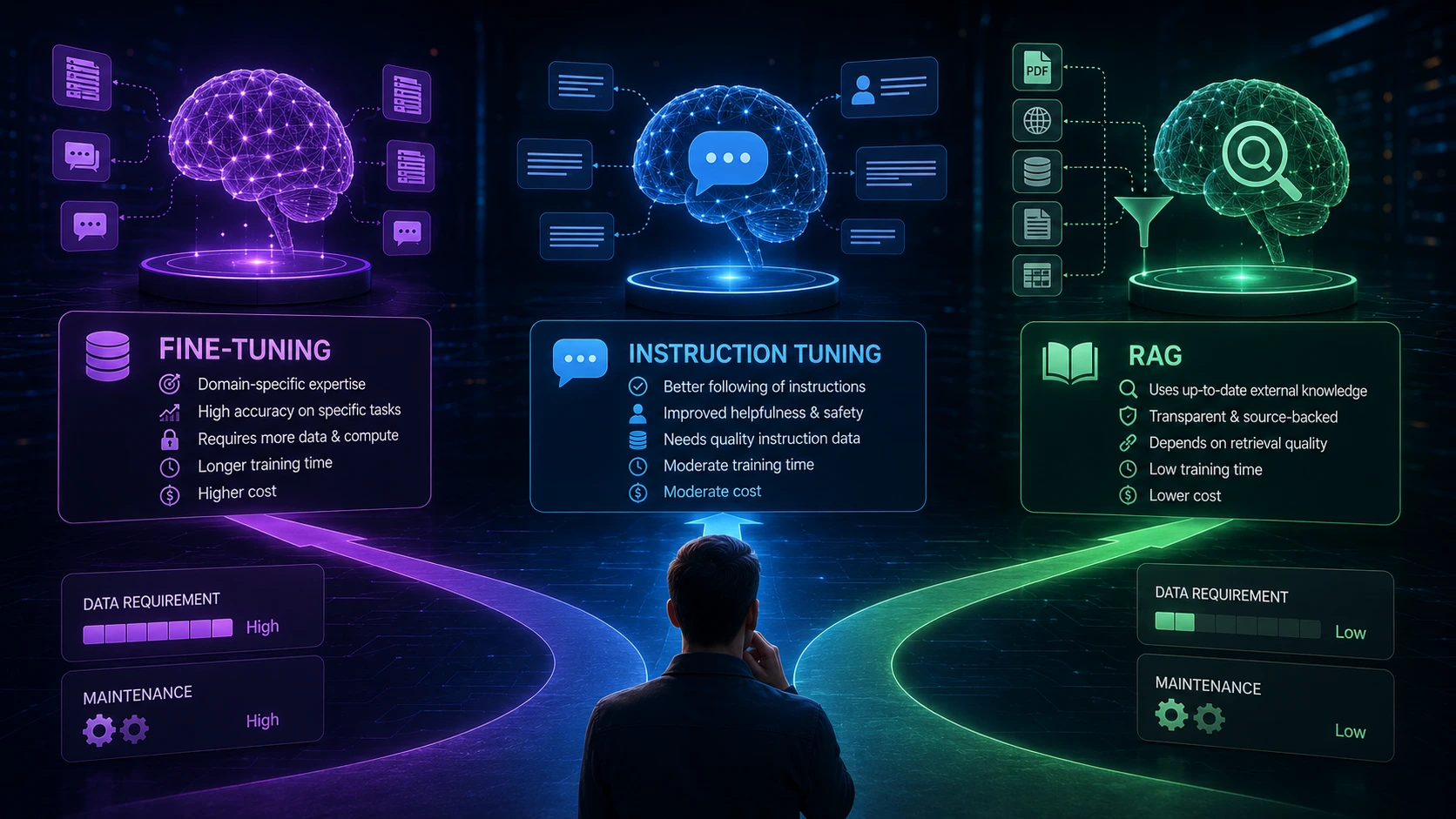
Teams building product features with large language models face the same strategic choice repeatedly: should you fine‑tune a model, apply instruction tuning, or rely on retrieval‑augmented generation (RAG)? This article lays out a practical decision framework that matches LLM customization strategies to common product constraints—data availability, performance targets, cost, latency, and maintenance overhead—so you can pick the least risky option that meets your goals.
Start with the decision dimensions that determine suitability
Before comparing approaches, quantify a small set of product constraints. Answering these questions narrows the field quickly:
- How much high‑quality task data do you have? (documents, labeled examples, user interactions)
- How often does the source knowledge change? (static handbook vs daily updates)
- How important is factual accuracy and provenance?
- What are your latency and cost targets per request?
- How complex or narrow is the desired behavior? (domain style guide, special safety rules, multi‑step reasoning)
- What are your operational constraints? (privacy, compliance, deployment access to models)
These dimensions are the axes you’ll trade off: accuracy and fidelity versus cost and operational complexity.
Option overview: strengths and typical use cases
Keep these short rules of thumb in mind when you compare fine‑tuning vs retrieval vs instruction tuning.
RAG (Retrieval‑Augmented Generation)
Best when you have a corpus of authoritative, frequently updated documents and you need up‑to‑date answers with traceable sources. RAG keeps the model generic and supplies context at inference time, which minimizes model updates and keeps costs predictable.
Instruction tuning
Instruction tuning adjusts a model’s response style and preferred behavior via curated instruction‑response examples without changing base model weights for domain content. Use it when you need consistent tone, formatting, or policy adherence but don’t need the model to memorize facts from private sources.
Fine‑tuning
Fine‑tuning alters model weights with labeled data so the model internalizes behavior or knowledge. It’s appropriate when you have substantial, high‑quality examples and you need low‑latency, compact deployments or highly specialized, repeatedly used behaviors that RAG would make awkward.
A decision flow: match constraints to the right approach
Follow this flow rather than treating choices as exclusive. Many production systems combine techniques.
- Is the knowledge dynamic and sourced from documents?
- If yes, prefer RAG. It lets you update knowledge by reindexing without retraining. If the corpus is small and static, fine‑tuning can work, but re‑training for every content change becomes painful.
- Do you need consistent behavior, formatting, or policy enforcement across prompts?
- If yes and the changes are about how the model responds (style, constraints), try instruction tuning or prompt engineering first. Instruction tuning reduces prompt fragility and is cheaper than repeated fine‑tuning for behavior changes.
- Is latency or cost per call extremely constrained?
- If you must avoid the two‑step retrieval + generation latency or retrieval API costs, fine‑tune a smaller model so answers are produced in one pass. Evaluate whether the accuracy tradeoffs and retraining costs are acceptable.
- Are there privacy or data residency constraints?
- If you cannot send private documents to a hosted retriever or external model, fine‑tuning or on‑prem RAG with a private vector store are the viable options. Instruction tuning can help reduce sensitive context in prompts but doesn’t remove the need to handle private data safely.
- How much labeled data do you have for the target behavior?
- If you have thousands of high‑quality examples, fine‑tuning can produce robust improvements. With hundreds, instruction tuning or careful prompt design is usually more cost‑effective. With none, RAG plus curated prompts is the low‑risk starting point.
Common product scenarios and recommended approaches
Concrete examples help choose between RAG vs fine‑tune vs instruction tuning.
Customer support knowledge base (frequently updated documentation)
Choose RAG. It provides up‑to‑date answers, can cite sources, and simplifies content owners’ workflows—update the index, not the model. Combine with lightweight instruction tuning to enforce response length and tone.
Legal contract summarization where accuracy and provenance matter
RAG with strong retrieval filters and source quoting is usually safest. If summaries must follow a firm template consistently, add instruction tuning to shape output format; reserve fine‑tuning for high volume, latency‑sensitive deployments that require internalized summarization rules.
Domain‑specific chatbot that must follow strict company policies
Instruction tuning to align behavior, plus RAG for factual anchors. If policy rules require deterministic behavior regardless of prompt wording, you may need fine‑tuning to bake those constraints into the model’s responses.
High‑throughput automation tasks (e.g., code generation inside IDE)
Fine‑tuning a smaller model often improves latency and offline availability. Combine with an internal retrieval cache for rarely changing docs. Test for regressions thoroughly—fine‑tunes can introduce unexpected behavior changes.
Hybrid approaches and practical rollout patterns
Most teams end up combining techniques because they address different problems:
- Start with RAG to get correct, up‑to‑date answers quickly. Add instruction tuning to stabilize output shape and policy adherence.
- When usage grows and latency or cost becomes a bottleneck, evaluate a targeted fine‑tune for the most frequent paths rather than retraining for everything.
- Use canary tests and behavior regression suites to compare fine‑tuned models to the baseline. Our site also has a practical checklist for testing RAG pipelines and catching regressions in LLM behavior.
Evaluation and success metrics that matter
Choose metrics that reflect product goals, not model lab scores. Useful measures include:
- Task completion rate and user satisfaction (NPS or thumbs up/down)
- Factual accuracy and citation correctness (for RAG)
- Response latency and cost per session
- Failure modes: hallucination rate, policy violations, and regression frequency after updates
Maintain a small automated test suite that exercises core paths and a human review workflow for edge cases. Testing and QA are especially important before rolling out fine‑tuned models because they can change behavior in subtle ways.
Operational checklist before you choose
- Estimate data volume and refresh cadence. If the corpus changes more than monthly, prefer RAG.
- Prototype with a baseline model and measure latency/cost with RAG and without. Use real sample traffic patterns.
- Assess data sensitivity and compliance requirements for retrieval and training data handling.
- Plan regression tests and rollbacks for any fine‑tuning experiment.
- Budget for ongoing maintenance: reindexing for RAG, retraining for fine‑tunes, or tuning datasets for instruction tuning.
There’s no universally best option—pick the approach that minimizes operational friction while meeting your fidelity and cost targets, and iterate from a low‑risk starting point.
Next steps for teams
If you’re evaluating choices for a new feature, start with a short experiment: build a RAG prototype (if you have documents), measure answer accuracy and latency, and run a small instruction tuning pass to standardize the output. Use those results to decide whether a targeted fine‑tune is worth the maintenance cost.
For more on implementing RAG systems and testing LLM behavior in production, see our practical posts on building reliable RAG pipelines and on LLM testing and QA.
Frequently Asked Questions
When should I choose RAG instead of fine‑tuning?
Choose RAG when your knowledge source is document‑based and updated frequently, when you need provenance, or when you want to avoid retraining. RAG lets you refresh content by reindexing rather than retraining the model.
What are the benefits of instruction tuning versus fine‑tuning?
Instruction tuning shapes response style, format, and policy adherence with fewer labeled examples and lower maintenance than fine‑tuning. It’s best for aligning behavior rather than internalizing domain facts.
How much data do I need before fine‑tuning makes sense?
There’s no hard cutoff, but practical experience suggests thousands of high‑quality examples for robust, generalizable gains. With only hundreds of examples, instruction tuning or prompt engineering is usually more cost‑effective.
Can I combine RAG and fine‑tuning?
Yes. A common pattern is RAG for up‑to‑date facts plus a targeted fine‑tune for high‑volume or latency‑sensitive paths. Instruction tuning can be layered to standardize tone and enforce policies.
What testing should I run before deploying a fine‑tuned model?
Run automated regression suites that cover core user flows, human evaluation for edge cases, hallucination and safety checks, and A/B tests comparing the fine‑tuned model with the baseline. Plan a rollback strategy.