Observability for LLM applications is not just about uptime and latency. For systems that generate text, recommend actions, or synthesize information, you need signals that show whether the model is correct, safe, and cost-effective. This article lays out pragmatic instrumentation patterns—what to measure, how to trace an LLM request end-to-end, and which prompt telemetry to capture—so you can detect regressions, investigate incidents, and build meaningful alerts.
Why LLM observability is different
Traditional app monitoring focuses on availability, latency, and error rates. LLM observability must include those basics, but also measures of correctness and intent: hallucination frequency, prompt drift, embedding distribution shifts, and token-level cost. The same API call can be “successful” from an infrastructure perspective while producing unsafe or incorrect output. Observability must bridge infrastructure telemetry and behavioral signals from the model.
Three signal layers to instrument
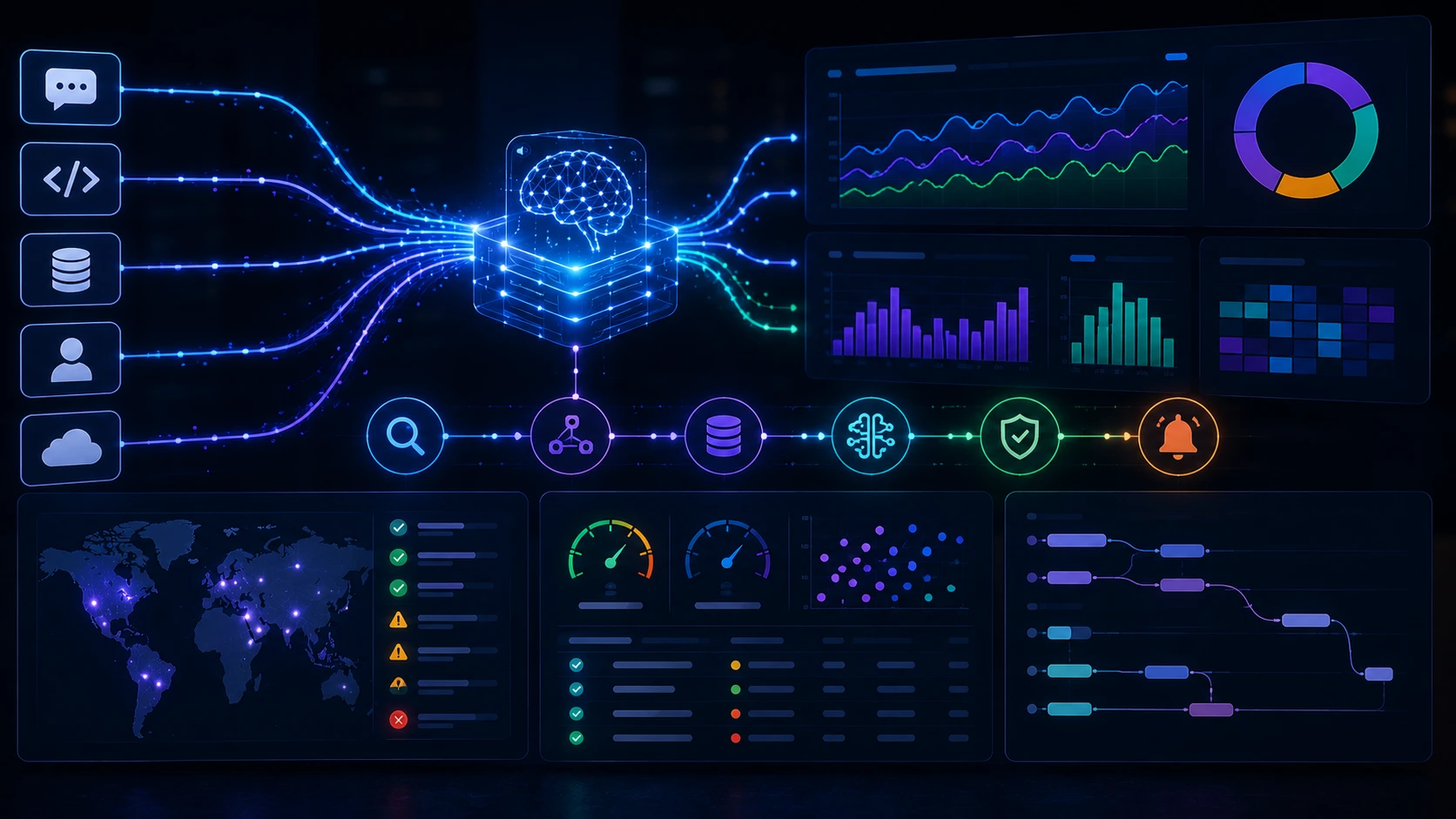
Think of observability for LLMs in three complementary layers:
- Metrics — aggregated numeric series for alerting and dashboards (latency, tokens, cost, success/quality rates).
- Traces — distributed traces that show a single request’s path across services: retriever, prompt builder, model call, post-processing.
- Prompt telemetry — structured records of the prompt (or a redacted/template version), model parameters, and contextual metadata for debugging and regression testing.
Key metrics to collect
Start with these metric categories; they form the baseline for meaningful alerts and SLOs.
- Performance: p50/p95/p99 latency of model calls, tokenization time, retrieval time, and end-to-end request latency.
- Usage & cost: tokens per request (prompt vs completion), average cost per request, model variant usage share, and daily spend trends.
- Reliability: API error rate, model timeouts, and throttling events.
- Correctness / QA: hallucination rate (from labelled samples), similarity-to-ground-truth for retrieval-augmented answers, regression-test pass rate, and user-facing satisfaction signals (thumbs up/down, escrows).
- Behavioral drift: change in embedding distribution, prompt template drift, or sudden increases in short/empty outputs.
These LLM metrics let you track both engineering health (latency, errors) and product health (accuracy, hallucinations).
Designing traces for AI application tracing
Distributed traces are essential for diagnosing where time is spent and how data flows. Instrument spans around each logical step of an LLM pipeline:
- Client request span (entry point).
- Retriever/document ingestion spans (for RAG systems).
- Prompt construction span (templating, variable substitution, enrichment).
- Model call span (external API call or local inference).
- Post-processing span (parsing, validation, filtering).
- Delivery span (response serialization and downstream events).
Tag spans with a stable request ID and include these attributes where possible: model name, model version, temperature, max_tokens, prompt template id/hash, retrieval document ids, and token counts. That contextual metadata makes traces actionable rather than just timing graphs.
{
"trace_id": "abc123",
"spans": [
{"name": "request", "duration_ms": 5},
{"name": "retriever", "duration_ms": 120, "docs": ["doc:42", "doc:87"]},
{"name": "prompt_build", "duration_ms": 10, "template_id": "tpl:invoice-summarize"},
{"name": "model_call", "duration_ms": 850, "model": "gpt-x-32k", "tokens": {"prompt": 420, "completion": 180} },
{"name": "post_processing", "duration_ms": 30}
]
}
What to capture in prompt telemetry
Prompt telemetry is the most sensitive and the most valuable. Capture a versioned, structured representation of what you sent to the model, not just a raw dump. A simple schema helps with debugging, regression testing, and aggregating identical prompts.
- Template metadata: template_id, template_version, and a hash of the rendered prompt (for grouping).
- Rendered prompt (redacted): either the full prompt for internal environments or a redacted form that strips PII for production telemetry.
- Model parameters: model_name, temperature, top_p, max_tokens, streaming flag.
- Contextual keys: user_id (hashed), session_id, request_id, retrieval_doc_ids, and other non-sensitive tags that help filter telemetry.
- Outputs and signals: generated text hash, token counts, model scores or logprobs (if available), and confidence signals from downstream validators.
Example prompt telemetry record:
{
"request_id": "req-2026-06-28-01",
"template_id": "tpl:customer-email-summary",
"template_version": "3",
"prompt_hash": "sha256:...",
"rendered_prompt_redacted": "Summarize the customer email: [REDACTED]",
"model": "gpt-x-16k",
"temperature": 0.0,
"tokens": {"prompt": 320, "completion": 50},
"generated_text_hash": "sha256:...",
"timestamp": "2026-06-28T12:00:00Z"
}
Practical instrumentation patterns
Follow these patterns to make telemetry reliable and low-friction.
- Use structured events: emit JSON-like events for prompt telemetry and model responses so downstream tooling can query fields without parsing raw text.
- Stable identifiers: assign a single request_id at the entry point and pass it through all spans, logs, and telemetry buckets.
- Template-first approach: store prompts as versioned templates. Log the template id/version and the rendered hash instead of keeping free-form prompts everywhere.
- Redaction and sampling: redact PII and sample full prompts in production. Capture full prompt payloads only in staging or for a small percentage of production requests.
- Token accounting: capture prompt and completion token counts at the time of the model call to attribute cost precisely.
Alerts and SLOs that matter
Good alerts connect a signal to an actionable outcome. For LLM apps, alerts should combine infrastructure signs with behavioral ones so you don’t wake up on a “false” success.
- Latency SLO: p95 end-to-end latency below X ms. Alert if breach persists for N minutes.
- Cost spike: sudden increase in tokens per request or model variant shift that raises daily spend beyond an anticipated pattern.
- Regression alert: drop in regression-test pass rate or increase in hallucination rate on a labelled test suite.
- Drift alert: embedding distribution shift or sudden change in prompt template usage indicating a deployment or content change.
- Quality degradation: sustained increase in manual negative feedback (thumbs down) correlated with prompt/template id or model version.
Alerting on aggregated metrics is necessary, but add low-volume tracing or canary pipelines that run synthetic queries through new model versions or prompt edits to catch regressions before they reach all users. For example, run 1% of traffic through a “canary” model version and compare its regression tests in real time.
Monitoring correctness and hallucinations
Detecting hallucinations requires labeled checks and heuristics. Combine automated validators with human-in-the-loop sampling:
- Maintain a small, curated test set for each intent with expected answers or properties. Run it against every deployment.
- Use similarity checks for RAG systems: measure retrieval-to-answer alignment and alert when the answer has low similarity to retrieved documents.
- Log model confidence proxies (e.g., token logprobs or probability mass) and correlate low-confidence outputs with user complaints or verification failures.
Labeling is expensive; prioritize tests around high-risk flows (billing, legal text, medical advice) and automate periodic sampling for lower-risk paths.
Storage, privacy, and sampling trade-offs
Telemetry volume can explode if you capture full prompts and outputs for every request. Be explicit about retention, sampling, and privacy:
- Decide which environments store full prompts (local/dev/staging) and which redact or hash content in production.
- Implement sampling tiers: 100% of metrics, 10% of traces, 1% of full prompts, adjustable per route or template.
- Apply automated PII redaction and mask identifiable fields before storing prompt text. Maintain a policy mapping templates to required redaction rules.
These trade-offs balance observability value against cost and compliance risk.
From observability to continuous quality
Observability should feed your release and QA cycles. Use telemetry to drive these tasks:
- Automate regression suites that replay sampled prompts and compare outputs to expected results. Integrate these checks into CI/CD for model or prompt template changes.
- Run canary experiments and automatically compare quality metrics between canary and baseline models using the same test set.
- Use telemetry to prioritize prompt fixes and template rollbacks by surfacing templates that correlate with low-quality outputs or cost spikes.
These practices align monitoring, testing, and release controls so observability becomes the engine of product stability.
Practical checklist to get started
- Instrument basic metrics: latency, error rate, tokens, and cost per request.
- Add distributed tracing that spans retriever, prompt construction, model call, and post-processing with a stable request_id.
- Implement prompt telemetry with template ids, prompt hashes, model params, and redaction rules.
- Create a small labelled test set for critical flows and run it automatically on deployments and canaries.
- Set alerts for latency/regression/cost anomalies and define clear runbooks for each alert type.
Where this fits in your broader LLM practice
Observability ties directly to cost management and QA. Track tokens and model usage to avoid unexpected spend (this connects to cost forecasting and budgeting for LLM products). Pair observability with regression suites that catch hallucinations and behavioral regressions so telemetry points to fixes instead of just symptoms.
Practical observability reduces mean time to detect and mean time to resolve—not by collecting every bit of data, but by collecting the right signals, consistently and with context.
Start small, iterate on the signals that expose real incidents in your product, and treat prompt telemetry as a first-class artifact of your application the same way you treat database queries or API calls.
Frequently Asked Questions
What is the minimum telemetry I should add for an LLM app?
Start with three things: (1) basic metrics — p95 latency, error rate, tokens per request, and cost per request; (2) distributed traces that include a request_id and spans for retriever, prompt build, model call, and post-processing; (3) prompt telemetry that records template_id, prompt_hash, model name, and token counts (with redaction in production).
How do I avoid storing sensitive user data in prompt logs?
Use template-based prompts and store the template id and a hash of the rendered prompt instead of raw text. Apply automatic PII redaction before telemetry is written, and sample full prompts only in staging or for a small production percentage.
How can I detect hallucinations automatically?
Combine a labeled test set for critical flows with heuristics: similarity checks to retrieved documents for RAG, low-confidence token indicators, and periodic human reviews of sampled outputs. Alert when regression tests fail or similarity metrics fall below thresholds.
What tracing attributes are most useful for debugging model issues?
Include request_id, model_name and version, prompt_template_id, prompt_hash, token counts (prompt/completion), and retrieval_doc_ids. These let you correlate slow spans with specific prompts or retrieval failures.
How should observability tie into release and QA processes?
Run regression suites and synthetic probes against every model or prompt template change, route a small percentage of traffic to canary models, and compare canary vs. baseline metrics. Use telemetry to prioritize rollbacks or prompt fixes based on concrete quality and cost signals.