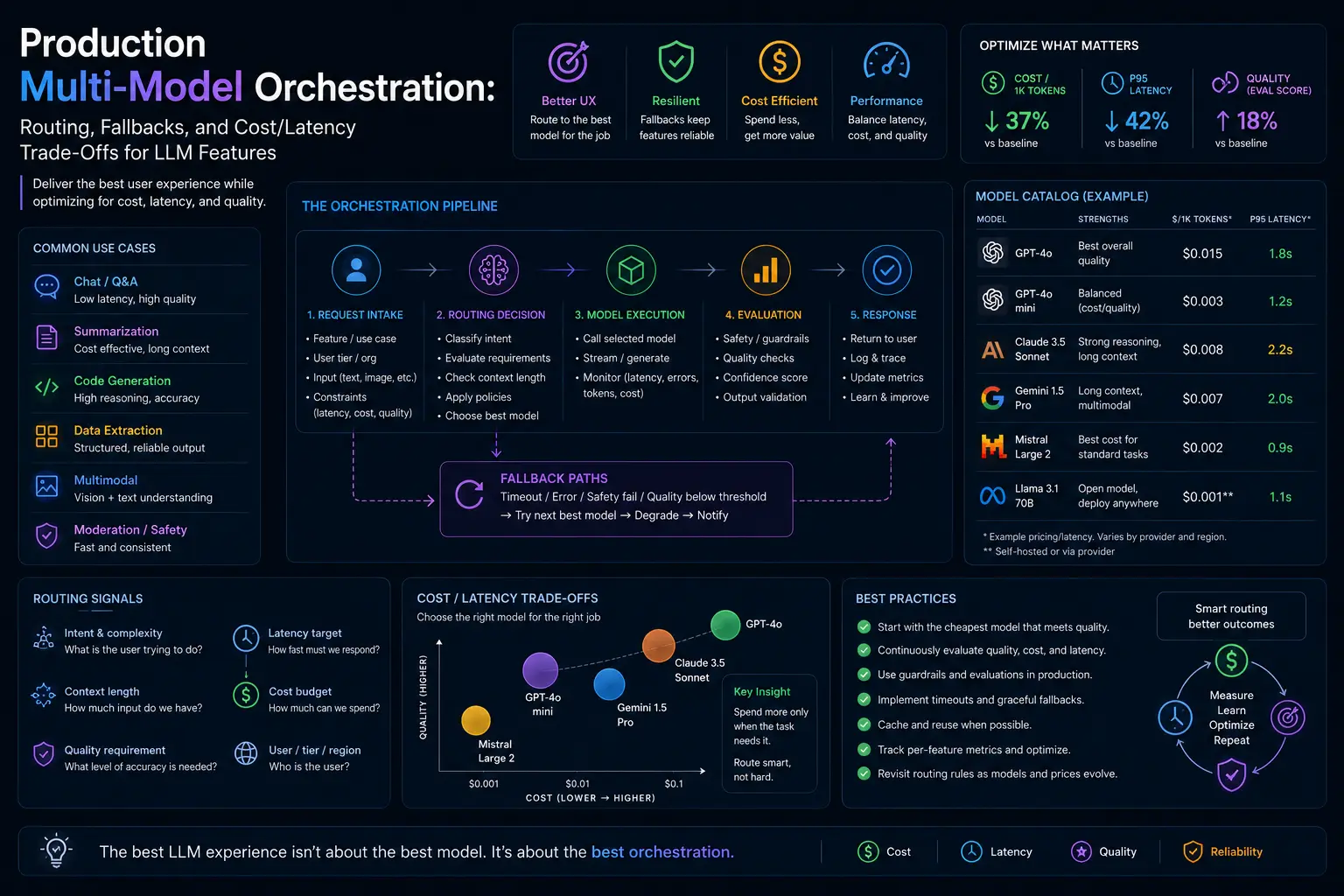
Running multiple LLMs in production is rarely about choosing one model and sticking with it. It’s about composing models to meet service-level objectives (SLOs), control cost, and keep latency predictable. This article lays out practical patterns for multi-model orchestration: how to route requests, design fallbacks, and balance cost versus latency when building LLM-backed features.
Why orchestrate multiple models?
Different LLMs trade off latency, price, and quality. A large, expensive model may produce the best text but costs more and runs slower; a smaller model is cheap and fast but less reliable on corner cases. Multi-model orchestration lets you combine strengths: route easy requests to fast models, escalate hard requests to larger models, and fall back gracefully when anything goes wrong.
Core principles for multi-model orchestration
Keep three principles front and center when designing orchestration:
- Objective-driven routing: define what matters (P95 latency, cost-per-1k-requests, accuracy thresholds) and encode those into routing rules.
- Observable decision points: log routing decisions, latencies, confidence, and final quality signals so you can tune policies with data.
- Fail-safe behavior: every request path should have a deterministic fallback that preserves user experience and SLOs.
Model routing strategies
Routing decides which model(s) handle a request. Choose a pattern that maps naturally to the user experience you need.
Rule-based routing
Use deterministic rules derived from request metadata: prompt type, token budget, user tier, or feature flags. Rule-based routing is easy to reason about and test—example rules:
- Short prompts (<128 tokens) → small, low-latency model.
- Billing-tier “enterprise” → priority routing to larger model.
- Requests flagged as code generation → model specialized for code.
Rule-based routing is low risk but can miss gray-area requests where quality matters more than obvious attributes.
Classifier-based routing
When rules aren’t enough, use a lightweight classifier to predict difficulty or required quality. Train the classifier on labeled historical requests (success/failure, human rating). It can predict which requests need an expensive model versus those a cheap model can handle.
Cost-aware and latency-aware routing
Inject cost and latency constraints into routing decisions. A simple approach is to compute a score per model combining expected cost, estimated latency, and predicted accuracy; select the model with the best score that still meets the request’s SLO.
Score(model) = w_quality * predicted_quality - w_cost * expected_cost - w_latency * expected_latency
Weights (w_*) reflect business priorities and should be tuned with real traffic.
Model selection for production: validation & profiling
Before routing live traffic, profile candidate models on a representative dataset. Measure:
- Token-level cost per request and average latency percentiles (P50, P95, P99).
- Quality on labeled examples relevant to your product (precision, recall, human ratings).
- Failure modes (timeouts, hallucination rate, malformed outputs).
Use those measurements as inputs to routing rules and the scoring function above.
Fallback and degradation strategies
A robust LLM fallback strategy protects user experience and budget when models fail, slow down, or return unacceptable outputs.
Common fallback patterns
- Graceful degradation: return a shorter, factual answer from a smaller model rather than failing outright.
- Cascaded fallback: small model → medium model → large model → human review. Each stage only escalates when necessary.
- Retry with adjusted parameters: reduce temperature, shorten max tokens, or tighten stop sequences on retry.
- Cached responses and idempotency: for repeat requests, reuse a prior response to avoid cost and latency.
Design fallbacks that are explicit and finite; avoid retry loops that increase cost without improving outcome.
When to fall back vs. when to escalate
Escalate (to a bigger model) when predicted quality is low or when a classifier flags a high-risk request. Fall back (to a smaller model or cached result) when latency or budget limits are about to be exceeded, or when a model times out. Use circuit breakers to automatically route traffic away from a failing model until it stabilizes.
Ensemble patterns and trade-offs
An ensemble of LLMs can improve quality but increases cost and architectural complexity. Pick the ensemble pattern that matches your SLOs.
Cascaded (filter-then-verify) ensembles
A fast model produces an initial answer and a verifier (or a larger model) validates or refines it only when necessary. This pattern minimizes calls to expensive models while preserving quality for difficult cases. It suits features where most requests are simple and a minority require high fidelity.
Parallel ensembles with reranker
Run two or more models in parallel and use a lightweight reranker or heuristic to choose the best output. This raises cost and the median latency to the slowest model, but can significantly improve correctness when outputs are complementary.
Voting and aggregation
For classification or structured outputs, aggregate multiple model outputs (majority vote, confidence-weighted voting). Voting reduces single-model bias but can fail when every model shares the same blind spot.
Balancing cost and latency: a pragmatic approach
Instead of guessing, model the economics of each routing decision. For a given request type you can compute expected cost and expected latency for each route:
expected_cost = P(cheap_success) * cost_cheap
+ P(fail_then_escalate) * (cost_cheap + cost_expensive)

expected_latency = latency_cheap + P(escalate) * latency_expensive
Use these expected values to pick a route that meets the target SLOs and budget. If P(escalate) is low, a cascaded strategy usually outperforms parallel ensembles on cost.
Example decision rule (simplified): choose the cheapest cascade whose expected_latency < SLO_latency and expected_cost < budget_per_request.
Operational practices
Orchestration is operationally heavy; instrument early and often.
- Capture routing metadata per request: chosen model, reason for routing, confidence scores, latency, final quality labels.
- Define SLOs (P95 latency, acceptable error/hallucination rates) and tie routing policies to SLO alerts.
- Shadow testing: route a fraction of traffic to new routing policies or models without impacting users to measure impact.
- Canaries and gradual rollout: change routing weights slowly and monitor. Use circuit breakers to revert automatically on degradations.
- Cost monitoring: trigger alerts when model spend exceeds forecast; our post "Cost Forecasting and Budgeting for LLM Products" covers practical budgeting steps.
Practical implementation patterns
Keep the orchestration layer thin and stateless where possible. Delegate heavy business logic to downstream services that can validate or reformat results.
// Pseudocode: simple cascaded router with fallback
function handleRequest(request) {
if (ruleClassifier(request) == 'easy') {
result = callModel('small', request)
if (isAcceptable(result)) return result
// escalate if small model failed quality check
return callModel('large', request)
}
// default to medium model for ambiguous requests
return callModel('medium', request)
}
Make isAcceptable() a small, deterministic check at first (format, length, toxicity), then a probabilistic quality check using stored classifiers or a fast verifier.
Checklist for shipping multi-model orchestration
- Profile candidate models on representative workloads (latency, cost, quality).
- Define SLOs that map to user experience and business constraints.
- Choose a routing strategy (rule-based, classifier-based, cost-aware) and codify it.
- Implement deterministic fallbacks and circuit breakers.
- Log routing decisions and outcomes; bake metrics into dashboards and alerts.
- Start with cascaded patterns for cost-sensitive features and use parallel ensembles selectively for high-value requests.
- Run shadow tests and phased rollouts before shifting large volumes of traffic.
Multi-model orchestration is an engineering trade-off: extra complexity delivers measurable improvements in cost control, latency management, and result quality when you design routing, fallbacks, and monitoring around real SLOs. Implement these patterns pragmatically, measure continuously, and tune policies with live data.
Frequently Asked Questions
When should I use cascaded routing versus parallel ensembles?
Use cascaded routing when most requests are simple and you want to minimize calls to expensive models. Choose parallel ensembles when correctness is critical for every request and you can accept higher cost and higher median latency.
How do I decide what constitutes an ‘acceptable’ response before escalating?
Start with deterministic checks (format, token length, profanity). Add lightweight quality signals: classifier-predicted correctness or a fast verifier. Tune thresholds using historical labels and shadow testing.
What metrics should I track to balance cost and latency?
Track per-route expected_cost, P50/P95/P99 latency, escalation rate (P(escalate)), and user-facing quality metrics (human ratings, error/hallucination rate). Combine these to compute expected_cost and expected_latency per routing policy.
How can I protect against sudden model failures or slowdowns?
Implement circuit breakers and automatic fallbacks to alternative models, monitor latency/error spikes, and use canary rollouts for policy changes so you can revert quickly if a model degrades.