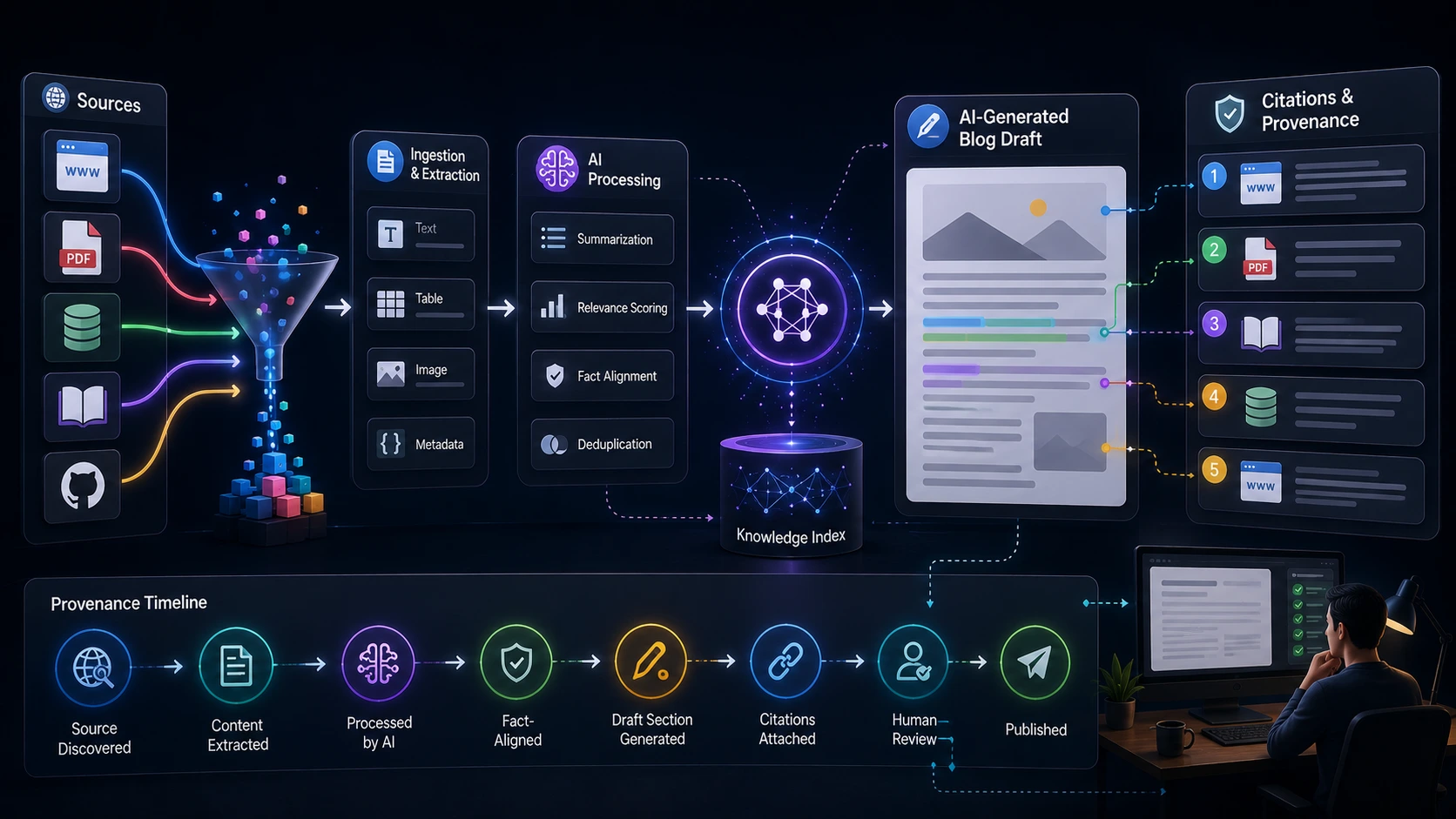

AI-assisted drafting speeds content creation, but it also introduces risk: confident-sounding inaccuracies, policy violations, and leaked private data can reach readers unless you catch them before publish. This article lays out concrete server-side patterns for hallucination detection for blog content and for building an AI content moderation pipeline that prevents bad outputs from becoming live posts.
What you should aim to catch on the server
Before wiring anything into a CMS publish hook, decide which failure classes your pipeline must stop. Typical categories:
- Factual hallucinations — incorrect claims, invented quotes, bogus statistics.
- Policy violations — hate speech, defamation, explicit content, or guidance that violates editorial rules.
- Privacy and PII leaks — email addresses, phone numbers, or private company data produced by the model.
- Style and brand — tone, length, or SEO gaps that break publishing standards.
- Structural issues — bad HTML, broken links, or malformed metadata that would harm the reader experience.
A practical server-side architecture
At a high level, the pipeline should sit between the editor (or LLM service) and your CMS publish action. Keep the runtime path simple: generate → validate → gate → publish. Each step can be synchronous (blocking) for small publishers or asynchronous (queued) for high-throughput systems.
Core pipeline components
- Claim extractor — parse the draft into discrete claims to verify (sentences that state facts, numbers, dates, people).
- Retrieval unit — use a lightweight RAG-style retrieval to fetch candidate evidence from your canonical sources (site archives, trusted news databases, academic indexes).
- Verifier — run automated comparison: document similarity, direct quote matching, and verification prompts to an LLM or specialized fact-check model.
- Policy classifiers — run toxicity, PII/NER, and legal-risk checks as separate detectors with conservative thresholds.
- Provenance & citations builder — attach evidence snippets and formatted citations for any claims the article includes.
- Gate and human review — block publish when checks fail or flag for human review depending on severity.
- Observability and audit log — record inputs, decisions, evidence, and reviewer outcomes for future tuning and compliance.
// Pseudocode: simplified server-side gating
draft = receiveDraftFromEditor()
claims = extractClaims(draft)
evidence = retrieveEvidence(claims)
verification = verifyClaims(claims, evidence)
policy = runPolicyChecks(draft)
if verification.hasHighRisk || policy.hasBlockers:
sendToHumanReview(draft, evidence, policy, verification)
else:
attachCitations(draft, verification.citations)
publish(draft)
Practical strategies for hallucination detection for blog content
Hallucination detection is not a single API call; it’s a collection of targeted checks. Use combinations of retrieval, lightweight heuristics, and model-based verification.
1. Extract and prioritize claims
Not every sentence needs verification. Use a claim-extraction model or rule-based parser to identify sentences with named entities, numeric values, dates, or assertions ("X causes Y"). Prioritize claims by impact—legal, reputational, or technical accuracy deserve higher scrutiny.
2. Use retrieval-backed verification
Pull supporting documents from trustworthy sources and compare the draft’s claims against those documents. For many publishing contexts the most useful sources are your site’s own archives, primary source documents, and a short list of domain-specific reference sites. Matching snippets, direct quotes, or corroborating facts reduce hallucination risk.
3. Run model-assisted contradiction checks
For claims with supporting evidence, ask a verifier model to answer a focused question ("Is claim X supported by evidence doc Y?") rather than asking a freeform fact-check. Structured prompts focusing on yes/no with a short justification lower the chance the verifier hallucinates.
4. Numeric and temporal sanity checks
Numbers and dates are frequent hallucination sources. Implement simple numeric diff thresholds and date-window checks—if the draft asserts a 2025 study but your evidence sources only show a 2022 paper, flag it for review. These deterministic checks are fast and reliable.
5. Cross-source corroboration and citation confidence
Require at least two independent corroborating sources for high-impact claims where feasible. When you attach citations, include snippets and metadata (title, source, retrieval timestamp) so reviewers can quickly assess provenance.
Automated safety checks: policy, toxicity, and PII
Policy enforcement should be modular and auditable. Prefer separate detectors for different risk types rather than a single monolith.
- Toxicity and hate-speech classifiers: Use models calibrated to your editorial policy. Tune thresholds conservatively to reduce false negatives; allow human override for borderline cases.
- PII detection: Named-entity recognizers combined with regexes (emails, SSNs) catch obvious leaks. Add a whitelist for permitted public figures or corporate contacts where appropriate.
- Legal & brand flags: Identify potential defamation or unauthorized claims about named people and organizations; escalate automatically.
Maintain clear severity levels for each detector: block, require review, or warn. Store the reason and evidence for every trigger in the audit log.
Integration patterns and trade-offs
Design choices will come down to latency, cost, and acceptable risk:
- Synchronous gating — block publish until checks complete. Best for small teams wanting near-zero risk but increases latency and compute cost.
- Asynchronous review — publish immediately but queue intensive checks and retract or annotate posts on failure. This reduces latency but requires robust rollback and reader-facing transparency.
- Hybrid — run fast deterministic checks synchronously and heavier verification asynchronously; block only on high-risk detections.
Expect trade-offs: stricter thresholds reduce false negatives but create more human workload. Track reviewer time per flag and tune detectors to optimize overall operating cost.
Testing, metrics, and iteration
Detecting hallucinations reliably requires measurement. Build a small test suite and a continuous evaluation loop:
- Curate a dataset of real-world drafts that include known hallucinations and policy violations.
- Measure detector precision and false positive rate against that dataset.
- Run canary deployments on low-traffic content to validate gating policies before wide rollout.
- Log reviewer decisions and use them as labeled data to retrain and calibrate models.
Useful operational metrics: percentage of drafts blocked, mean time to review, reviewer override rate, and post-publish retraction incidents.
Operational considerations
Some practical topics that teams often overlook:
- Observability: collect prompt/response snapshots, detector outputs, and evidence retrieval results. That trace makes debugging and compliance auditing possible.
- Versioning: tie every published article to the exact model, prompt templates, and retrieval index versions used during validation.
- Privacy: scrub or encrypt drafts when they contain sensitive customer data; apply stricter retention rules for detection logs involving PII.
- Reviewer UX: present evidence, suggested edits, and an explanation for each flag. Faster triage reduces review overhead.
Minimal viable checklist to deploy in weeks
- Instrument claim extraction and run a simple NER + regex PII detector.
- Wire an internal retrieval index of canonical sources (site archives, primary references).
- Implement a verifier prompt that compares a claim to top-k retrieved documents and returns support/conflict/unknown.
- Hook toxicity and PII classifiers; set conservative block thresholds for obvious violations.
- Create an audit log that stores the draft, detector outputs, and verification snippets.
- Start with human-review gating for any blocked output; collect reviewer decisions as labels.
- Measure detection precision and reviewer time for two weeks, then tune thresholds and add automation where reliable.
When detector mistakes happen: a practical remediation policy
Have a clear failure plan: soft-block (prevent publish), hard-block (prevent action until legal signs off), or post-publish remediation (correct and add a correction note). Use severity, confidence, and content category to pick the appropriate path. For public-facing mistakes, keep a templated correction workflow to minimize brand damage.
Final practical advice
Start with a narrow goal: protect high-risk claims and prevent policy violations. A small, well-calibrated server-side pipeline that combines deterministic checks, retrieval-backed verification, and human-in-the-loop review will eliminate the majority of harmful outcomes without imposing unsustainable review burdens. Iterate based on real reviewer feedback and measured metrics: detection systems improve fastest when reviewers’ decisions feed back into the detectors and the retrieval index.
Focus first on accuracy-critical claims, repeatable checks (numbers/dates/quotes), and clear policy violations—those give the best safety return for the least engineering effort.
Frequently Asked Questions
What is the most effective single step to reduce hallucinations in AI-generated posts?
Use retrieval-backed verification: extract claims and check them against trusted documents (your archives or authoritative sources). Verifying structured claims with evidence reduces many common hallucinations.
Should verification be synchronous or asynchronous before publishing?
It depends on risk tolerance. Synchronous gating eliminates most risk but increases latency and cost. A hybrid approach—fast deterministic checks sync, deeper verification async—balances speed and safety.
How do I reduce false positives that overwhelm reviewers?
Prioritize claims by impact, tune classifier thresholds using labeled reviewer data, and present clear evidence and suggested edits in the reviewer UI to speed triage.
Can an LLM alone reliably fact-check another LLM?
LLMs can help, but use them with retrieved evidence and constrained prompts (yes/no + short justification). Pair model-based checks with deterministic rules (numeric/date checks) and cross-source corroboration for robust results.
What operational logs should I keep for audits?
Store the draft snapshot, detector outputs, retrieved evidence snippets, model/prompt versions, reviewer decisions, and timestamps. Encrypt or minimize retention for any logs containing PII.