Introduction
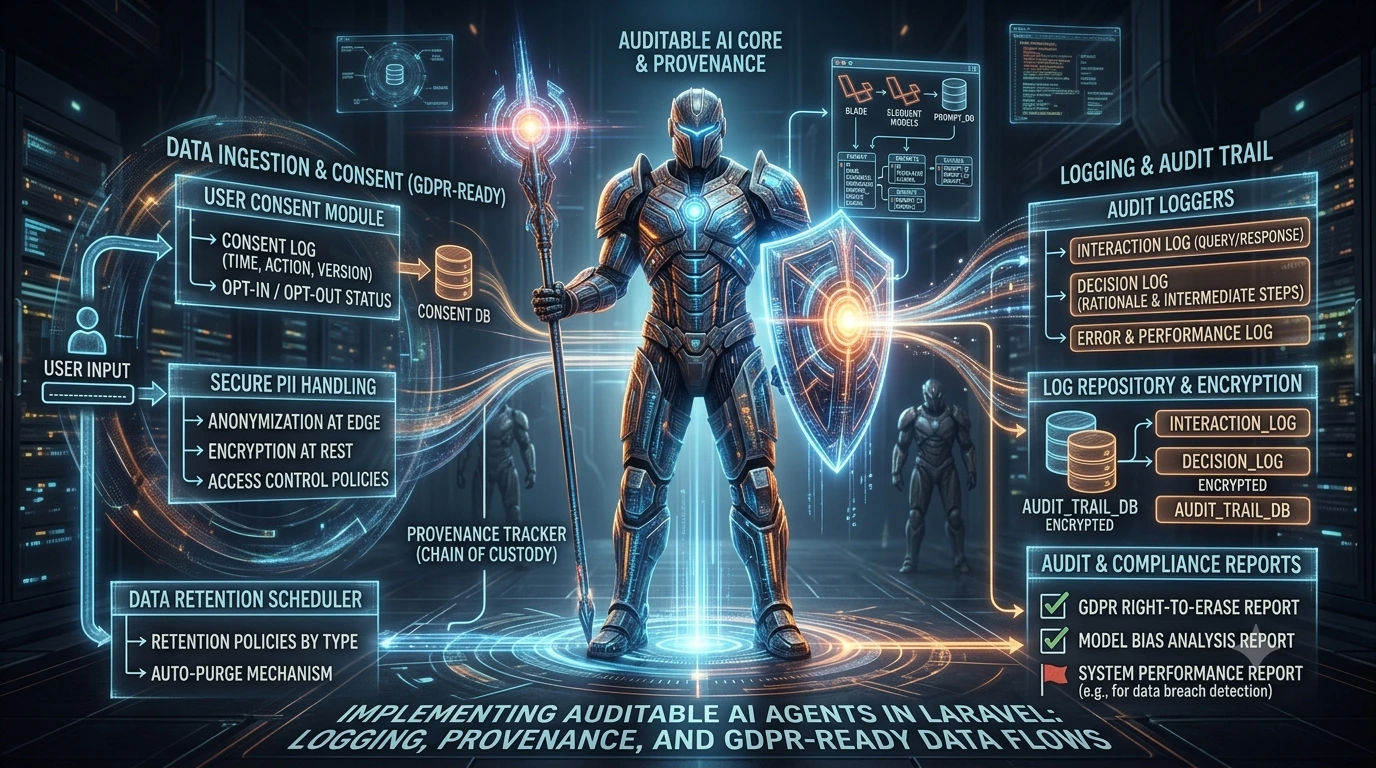
As AI agents move from prototypes into production, teams must make their behavior auditable: capture what the agent saw, why it decided, and who or what changed the result. Auditable AI agents are essential for debugging, security investigations, and regulatory compliance (GDPR, sector rules). This guide shows how to implement structured AI audit logs, provenance tracking, and retention/redaction controls in a Laravel application so you can answer “what happened?” and “how can we prove it?” without storing unnecessary sensitive data.
What to log (and what to avoid)
Design your audit plan around three goals: decision traceability, minimal exposure of personal data, and tamper resistance. At minimum, log the following for every agent action:
- Agent run identifier (UUID) and step index
- Timestamp and actor (system, user id, or service account pseudonym)
- Inputs supplied to the model (redacted or hashed when sensitive)
- Model metadata (model name/version, prompt template, temperature)
- Model output and any post-processing or tool calls
- Decision reason or rationale if produced (or human rationale when overridden)
- Confidence scores, external tool results, and success/failure status
Avoid logging raw personal data unless strictly necessary. If you must keep raw values for operational or legal reasons, store them encrypted, separately from searchable indexes, and restrict access to a compliance-only workflow.
Design principles for auditable AI agents
- Logs as primary data: Treat audit logs as first-class data (structured, queryable, and versioned).
- Separation of concerns: Keep application data, operational logs, and audit logs in distinct stores and roles.
- Immutable provenance: Link events with cryptographic hashes to detect tampering.
- Data minimization: Log the smallest representation that preserves traceability (hashes, pseudonyms).
- GDPR safety: Provide redaction/erasure paths and record lawful basis for processing.
Data model and migrations (Laravel examples)
Two tables are a good starting point: a run-level table for the agent invocation and a granular log table for each step or tool call.
// database/migrations/xxxx_xx_xx_create_ai_agent_runs_table.php
public function up()
{
Schema::create('ai_agent_runs', function (Blueprint $table) {
$table->uuid('id')->primary(); // run id
$table->string('agent_name');
$table->uuid('initiator_id')->nullable(); // pseudonym or user id
$table->json('metadata')->nullable(); // model version, environment
$table->string('provenance_root_hash', 128)->nullable();
$table->timestamps();
});
}

// database/migrations/xxxx_xx_xx_create_ai_agent_logs_table.php
public function up()
{
Schema::create('ai_agent_logs', function (Blueprint $table) {
$table->id();
$table->uuid('run_id');
$table->unsignedInteger('step_index');
$table->string('event_type');
$table->json('payload'); // structured inputs/outputs or redacted variants
$table->string('payload_hash', 128); // SHA-256 hex digest
$table->string('prev_hash', 128)->nullable(); // for chain linking
$table->string('provenance_hash', 128)->nullable(); // cumulative chaining
$table->timestamps();

$table->index('run_id');
});
}
This structure keeps each atomic action recorded with a hash chain to support tamper detection.
Structured logging patterns and Laravel integration
Use structured JSON logs instead of free-form strings. Store a normalized payload in the DB and echo an abbreviated event to a secure log channel. Here’s an example payload shape to standardize on:
{
"run_id": "uuid",
"step": 2,
"actor": { "type": "user", "id_hash": "hmac:..." },
"model": { "name": "gpt-4o", "version": "2026-06" },
"input": { "text_redacted": "", "input_hash": "sha256:..." },
"output": { "text": "Answer...", "score": 0.87 },
"tools": [{ "name": "pdf_reader", "result": "..." }],
"reason": "extracted invoice date",
"timestamp": "2026-06-27T12:34:56Z"
}
Example Laravel helper (trait) to record a step. The trait shows redaction + hashing + storage logic in one place.
// app/Traits/LogsAiAgentStep.php
trait LogsAiAgentStep
{
protected function logAgentStep(string $runId, int $step, string $eventType, array $payload)
{
// Redact sensitive fields before persisting searchable payload
$safePayload = $this->applyRedactionRules($payload);

$payloadJson = json_encode($safePayload, JSON_UNESCAPED_SLASHES);
$payloadHash = hash('sha256', $payloadJson);

// Retrieve previous step hash to chain provenance
$prevHash = DB::table('ai_agent_logs')
->where('run_id', $runId)
->orderBy('step_index', 'desc')
->value('provenance_hash');

$provenanceHash = hash('sha256', ($prevHash ?? '') . $payloadHash . $step);

DB::table('ai_agent_logs')->insert([
'run_id' => $runId,
'step_index' => $step,
'event_type' => $eventType,
'payload' => $safePayload,
'payload_hash' => $payloadHash,
'prev_hash' => $prevHash,
'provenance_hash' => $provenanceHash,
'created_at' => now(),
'updated_at' => now(),
]);

// Also write to external structured log channel for ops (optional)
Log::channel('ai_audit')->info('ai.step', ['run_id' => $runId, 'step' => $step, 'hash' => $provenanceHash]);

return $provenanceHash;
}
}
Implementing a provenance chain
Link each log entry by storing:
- payload_hash — SHA-256 of canonicalized payload
- prev_hash — previous entry’s provenance_hash
- provenance_hash — hash(prev_hash || payload_hash || step_index)
This simple chain allows efficient verification of an agent run. To verify, recompute payload hashes from stored payloads and walk the chain. For higher assurance, consider signing the provenance_hash with a private key or using an append-only store (WORM) or an external tamper-evident log service.
// Verifier pseudo-code
function verifyRun(runId) {
entries = loadEntriesOrdered(runId);
prev = '';
foreach (entries as e) {
payloadHash = hash(e.payload_json);
expectedProv = hash(prev . payloadHash . e.step_index);
if (expectedProv !== e.provenance_hash) return false;
prev = expectedProv;
}
return true;
}
GDPR-ready data flows: retention, redaction, and DSAR handling
GDPR requires you to be able to honor rights such as access and erasure. For auditable agents, build two primary capabilities:
- Configurable retention: Implement scheduled jobs that prune or redact logs after a retention period determined by lawful basis. Keep separate retention windows for operational logs and compliance-only encrypted backups.
- Selective redaction / erasure: When a DSAR asks for erasure, do not rely on deleting entire audit trails. Instead, replace personal data in logs with irreversibly redacted placeholders while preserving hashes and provenance markers required for forensic integrity.
Example artisan command for scheduled redaction:
// app/Console/Commands/RedactOldAiLogs.php
public function handle()
{
$cutoff = now()->subDays(config('audit.retention_days'));

$rows = DB::table('ai_agent_logs')
->where('created_at', '<', $cutoff)
->whereNull('redacted_at')
->get();

foreach ($rows as $row) {
$payload = json_decode($row->payload, true);
$payload = $this->redactPayload($payload);

DB::table('ai_agent_logs')->where('id', $row->id)
->update(['payload' => $payload, 'redacted_at' => now()]);
}
}
Key recommendations for GDPR compliance:
- Document the lawful basis for each category of logged data (consent, legitimate interest, contract performance).
- Pseudonymize user identifiers in logs using HMACs with a rotation-aware key.
- Encrypt raw sensitive payloads at rest using Laravel encryption or KMS-wrapped keys; store encrypted copies only when necessary and audit access.
- Provide an operational DSAR workflow that returns redacted logs, plus a compliance process for decrypting raw values when legally required.
Operational controls: access, monitoring, and integrity checks
Logging alone is not enough. Apply controls to ensure logs themselves are secure and useful:
- Limit read/write access to audit tables; require elevated roles for raw payload decryption.
- Ship structured logs to a secure log sink (S3 with object lock, immutable log service, or SIEM) and enable versioning/audit trails on that sink.
- Monitor for anomalous agent behavior (spikes in external tool calls, sudden changes in output distributions) and trigger alerts.
- Run regular verification jobs that validate provenance chains and report tamper indicators to security teams.
Practical checklist before production
- Define the minimal set of fields to log for every agent action and codify them in a schema.
- Create Laravel migrations and models for runs and step logs; migrate to a separate, access-controlled DB/schema if required.
- Implement structured logging helpers and enforce redaction rules at the source of logging.
- Build provenance chaining and verification jobs.
- Configure retention and redaction commands and add them to scheduler.
- Document lawful bases, DSAR procedures, and add an emergency access workflow for compliance.
- Run a privacy impact assessment (DPIA) if processing sensitive personal data or high-risk profiling.
Log the decision, not just the output — but log the smallest representation of personal data that still allows you to reconstruct reason and context.
Example scenario: invoice-extraction agent
Imagine an agent that ingests invoices and extracts line items. For traceability you should:
- Record run_id, model and tool calls (OCR engine, table extraction), input file hash (SHA-256), and extraction output.
- Redact or encrypt customer names in the stored payload; keep HMAC identifiers for linking to the original customer when needed.
- Store a provenance chain across steps: receive file → OCR → parse → validate → output. If a later audit finds a bad extraction, you can replay or inspect the chain and the tool results.
Next steps and where to customize
Every organization has different risk appetite and compliance needs. Start with the patterns above and adapt these variables:
- Retention windows by data category (e.g., 30 days for debug logs, 2 years for compliance records)
- Redaction rules and allowed decrypted access roles
- Provenance assurance level (simple hash chain vs. signed chain vs. append-only audit log service)
Implementing auditable AI agents in Laravel is an engineering and product design challenge: balance operational observability with privacy, build tamper-evident chains for trust, and provide clear DSAR/redaction paths. The patterns above will give you a pragmatic, GDPR-aware foundation for production-grade AI agents.
Frequently Asked Questions
What are auditable AI agents and why are they important?
Auditable AI agents are AI-driven processes instrumented to record inputs, model metadata, outputs, and decision rationale in a structured, tamper-evident way. They are important for debugging, security forensics, compliance (GDPR, sector rules), and user trust because they let teams answer what the agent did and why.
Which fields should I log for AI decision traceability?
At a minimum: run ID, step index, actor (user or system), canonicalized inputs (or input hash), model metadata (name, version), model outputs, confidence scores, tools called, timestamps, and any human overrides. Avoid storing unnecessary raw personal data — use hashes or pseudonyms.
How can I make audit logs GDPR-compliant?
Apply data minimization and pseudonymization, encrypt sensitive payloads at rest, provide a redaction/erasure workflow for DSARs that preserves provenance markers, and document the lawful basis for logging. Use retention policies and implement scheduled redaction/deletion jobs.
What is a provenance chain and how do I implement it?
A provenance chain links log entries using cryptographic hashes: compute a payload_hash for each entry, and then compute provenance_hash = hash(prev_provenance_hash || payload_hash || step_index). Store prev_hash and provenance_hash for every entry. To verify integrity, recompute hashes and walk the chain; for higher assurance sign the provenance hash or use an append-only log.
Should I store raw inputs to allow replaying agent runs?
Store the minimum needed to replay safely. For operational debugging you may keep encrypted raw inputs in a separate, access-controlled store and log a redacted/searchable payload in the main audit table. Make replay access subject to strict controls and audit.