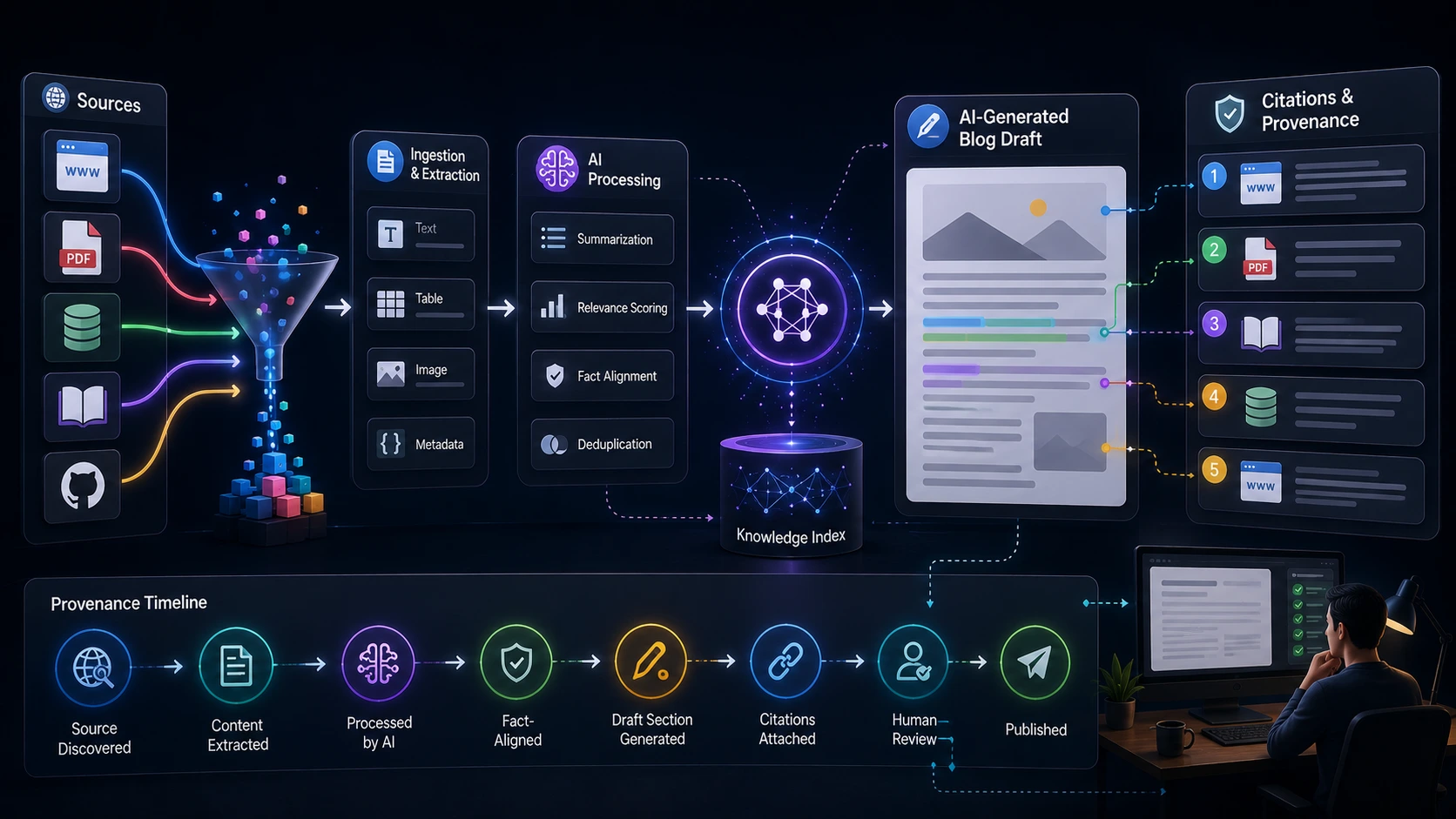

Keeping editorial features fast, consistent, and affordable requires more than picking a single model. Teams building AI features for a blog platform must decide which requests go to which models, when to reuse results, and how to degrade gracefully when budgets or latency constraints bite. This article lays out concrete policies and patterns—routing rules, caching practices, fallbacks, and monitoring—that keep editorial workflows high quality without runaway LLM spend.
Core principles for cost‑aware orchestration
Before designing rules, settle a few guiding principles that resolve trade-offs when they appear in production:
- Prioritize value-per-cost: route expensive models to tasks where higher quality measurably improves the editorial outcome (e.g., headline rewriting, final copy edit).
- Prefer deterministic or cached outputs where possible; reserve generation for genuinely novel or high-value work.
- Fail fast and degrade predictably: users should get a reasonable default instead of an error or long wait.
- Measure at the feature level: track tokens, latency, and cost per feature rather than aggregating across the whole product.
Model routing strategies that balance quality and cost
Design routing as a small set of deterministic rules applied before the call is made. A practical routing policy is a decision tree with a handful of checks that map requests to model classes.
Common routing knobs
- Feature intent: classify the request type (draft generation, headline rewrite, fact-check, autocomplete) and assign a model tier. For example, use a cheaper local model for autocomplete, a mid-tier for drafts, and a high-quality model for final rewrites.
- Complexity score: compute a light-weight heuristic (prompt length, number of embedded links, presence of code blocks or citations) and escalate to stronger models only when the score exceeds a threshold.
- User tier: route premium or staff accounts to higher-tier models while sending anonymous or low-value traffic to cheaper alternatives.
- Token budget: if estimated tokens for a request exceed a configured limit, split the job (summarize then expand) or route to a less costly model with tighter constraints.
- Temporal policies: during peak load or budget constraints, temporarily raise routing thresholds or divert non-critical work to cached or offline pipelines.
Example policy (expressed informally): if feature == "final_headline_edit" AND user_role in {editor,paid} -> send to high-quality model; else if complexity_score < 0.3 -> small model; else -> mid-tier model.
Caching AI completions: what to store and how
Caching is the single most effective way to reduce repeated costs for deterministic or semi-deterministic outputs. But indiscriminate caching leads to stale or incorrect content. Use precise cache keys and eviction policies.
Cache key design
A robust key includes the normalized prompt template, a hash of variable inputs, the model identifier and model settings that affect output (temperature, max_tokens, system instructions), and a content version or timestamp when relevant. Normalizing whitespace, sorting metadata, and canonicalizing URLs reduce false misses.
// pseudo-code: build a cache key
key = hash(
template_id + '|' +
normalize(user_input) + '|' +
model_name + '|' +
temperature + '|' +
context_version
)
Don't include ephemeral or user-specific unrelated fields (like session IDs) in the key.
Cache policies and TTL
- Use short TTLs (minutes to hours) for outputs that depend on fresh content (news snippets, live metadata).
- Use longer TTLs (days) for stable results (templated summaries, common editorial rewrites) and invalidate on content update.
- Store both final completions and intermediate artifacts (e.g., extracted structured data) so you can rebuild or rehydrate outputs without recomputing everything.
- Monitor cache hit rate by feature; hits directly translate into token and cost savings.
For non-deterministic models (temperature > 0), consider two approaches: normalize or canonicalize prompts so outputs become more repeatable, or limit caching to use-cases where variation doesn't matter (e.g., A/B variants with fixed seeds).
Token cost reduction patterns
Reduce tokens without degrading outcomes by trimming what you send to the model and controlling returned tokens.
- Prompt compression: summarize long context or use extracted highlights rather than sending the entire article body.
- Retrieval-first: fetch a small set of relevant facts with embeddings and include only those passages in the prompt. This is effective for fact-aware edits and reduces context size.
- Instruction brevity: move static instructions to system-level defaults or use concise templates that reuse placeholders rather than repeatedly sending long guidance.
- Output limits: enforce strict max_tokens and prefer a two-step flow (concise draft then optional expansion) so expensive length is optional and gated.
When possible, precompute summaries or use an offline pipeline to generate boilerplate content. For guidance on retrieval pipelines, see our post on building a RAG pipeline for blog search and snippets.
Hybrid LLM deployment: mixing models strategically
Hybrid deployment means using multiple model types—open-source, hosted smaller models, and premium cloud models—in a deliberate mix. The goal is a coarse-to-fine processing pipeline that reserves the most costly resource for the last crucial step.
Coarse-to-fine pattern
1) Fast, cheap model: produce a first-pass draft, extract structure, or perform classification.
2) Mid-tier model: refine tone, correct grammar, handle moderate complexity.
3) High-quality model: final polish, creative rewrites, or complex instruction handling. Use the earlier routing rules to determine when to escalate.
This pattern reduces unnecessary calls to the high-cost model and lets you cache earlier outputs for reuse. It also supports shadow testing: run an expensive model in parallel without serving its output, to compare quality before changing routing rules.
Fallbacks and graceful degradation
Even with careful routing, models or budgets can fail. Define a predictable degradation path so users still get useful results.
- Cached fallback: return the last known good completion for the item if a live call fails or is rate-limited.
- Template fallback: supply a deterministic template or human-authored default for critical UI elements (headlines, description snippets).
- Deferred rewrite: serve a fast, lower-quality draft immediately and queue a background job to produce a higher-quality rewrite later, notifying the user when it’s available.
- Rate-limited queue: throttle expensive calls and spill lower-priority work into a time-windowed queue to stay within daily budgets.
Document the user-visible trade-offs: if a deferred rewrite is used, show a status indicator so editors understand why quality might change later.
Monitoring, budgets, and operational policies
Policies only hold if you measure and enforce them. Track these metrics by feature and by model:
- tokens_sent and tokens_recv per request
- cost_per_request and cost_per_feature
- cache_hit_rate and average_cache_savings
- latency percentiles (p50/p95/p99)
- routing_escalation_rate (percentage of requests sent to higher-tier models)
Use these metrics to implement automated guardrails: per-feature daily spend limits, model-specific throttles, and alerts when token usage deviates from forecast. Have an operational playbook that includes an emergency rate-limit toggle to prevent runaway costs.
Testing and rollout: safe ways to change routing
Change model routing gradually and measure user impact:
- Shadow testing: run new routing rules or candidate models in parallel, record differences, and evaluate editorial quality before shifting traffic.
- Canary rollout: expose a small fraction of traffic to new rules or models and compare objective metrics (latency, cost) and subjective metrics (editor satisfaction).
- A/B quality checks: surface paired comparisons to editors for features that matter (e.g., headline quality) so human judgment informs routing decisions.
Practical checklist to implement in 4 weeks
- Define model tiers and map features to initial routing rules.
- Implement canonical prompt templates and a cache with explicit keys and TTLs for high-hit features.
- Introduce token budgeting per feature and an emergency throttle mechanism.
- Instrument cost and token metrics by feature; configure alerts when spend diverges from forecast.
- Run shadow tests for any change that routes traffic to a higher-cost model and evaluate quality uplift before committing.
Practical orchestration is about predictable trade-offs: reduce unnecessary calls, cache what’s safe to reuse, escalate only when quality matters, and measure everything per feature.
Where to start next
Begin with the features that account for most of your LLM spend and apply a routing + caching policy to them first. For teams building retrieval-aware features, integrating a RAG pipeline reduces context size and token spend; for routing design and fallbacks, our post on production multi-model orchestration covers complementary tactics and examples.
Frequently Asked Questions
How should I choose which model a request should go to?
Use a small decision tree: identify the feature intent (draft, final edit, autocomplete), compute a lightweight complexity score, and consider user tier. Route only high-value or high-complexity requests to premium models.
Can I cache non-deterministic model outputs?
Yes, but carefully. Cache when variation doesn't matter (e.g., deterministic templates) or reduce nondeterminism by fixing seeds, lowering temperature, or canonicalizing prompts before caching.
What metrics matter for controlling LLM cost?
Track tokens_sent/received, cost_per_request, cache_hit_rate, latency percentiles, and routing_escalation_rate. Measure these by feature and set budget alerts per feature.
When is a hybrid deployment (mixing open-source and premium models) worth it?
Introduce hybrid deployment when you can clearly split workload into low-value, high-volume tasks (handled by cheaper models) and small, high-value tasks that need premium quality. Use a coarse-to-fine pipeline and shadow testing first.
How do I degrade gracefully if budget or latency constraints occur?
Implement cached fallbacks, deterministic templates, and deferred background rewrites. Expose status to editors so they understand when a result might be temporary or lower quality.