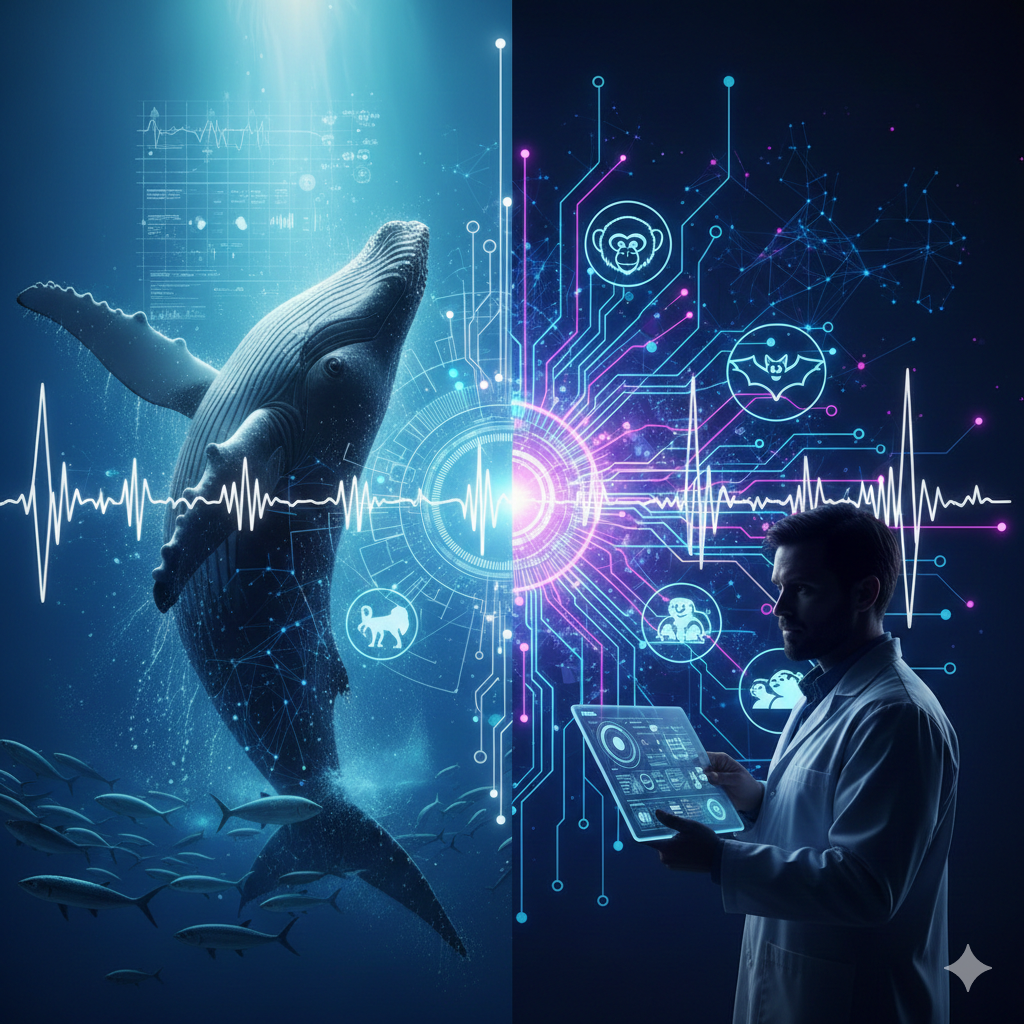
The dream of understanding animals has captivated humanity for millennia. From folklore to scientific study, we've yearned to comprehend the rich tapestry of their thoughts, feelings, and social structures. Now, in the age of artificial intelligence, that age-old dream is beginning to look less like science fiction and more like a tangible possibility.
The Challenge of Animal Language
Animal communication is incredibly complex. It's not just about simple calls or mating displays. It involves:
-
Vocalizations: A vast array of sounds, from whale songs spanning hundreds of miles to the subtle chirps of insects.
-
Body Language: Postures, movements, and gestures that convey meaning.
-
Chemical Signals: Pheromones and other scent markers.
-
Environmental Cues: Interactions with their surroundings.
The sheer volume and subtlety of these signals make manual analysis incredibly time-consuming and often subjective. This is where AI steps in.
How AI is Cracking the Code
Artificial intelligence, particularly machine learning and deep learning, offers powerful tools to analyze and interpret animal communication in ways never before possible:
-
Pattern Recognition at Scale: AI algorithms can process immense datasets of animal sounds and behaviors, identifying subtle patterns, correlations, and structures that human observers might miss. Think of analyzing thousands of hours of bat echolocation calls or primate vocalizations.
-
Contextual Analysis: Beyond just identifying individual sounds, AI can help understand the context in which these communications occur – who is communicating, their emotional state (inferred from bio-signals), and the environmental factors at play.
-
Cross-Modal Integration: AI can combine data from various sources: audio recordings, video footage of body language, physiological data (like heart rate), and even environmental sensor data to build a more holistic picture of animal communication.
-
Generative AI for Synthesis and Hypothesis Testing: While still nascent, some researchers are exploring generative AI to create "responses" that mimic animal communication patterns, allowing them to test hypotheses about how animals might interpret certain signals.
Pioneering Projects and Exciting Discoveries
From the "Project CETI" (Cetacean Translation Initiative) aiming to understand sperm whale communication using advanced AI, to projects deciphering the complex alarm calls of vervet monkeys or the social interactions of prairie dogs, the field is buzzing with innovation. Early findings are revealing nuanced "dialects," individual identifiers within group calls, and even potential "referential" communication where specific calls refer to specific things.
Ethical Considerations and the Road Ahead
While the potential is immense, several critical considerations arise:
-
Interpretation vs. Translation: Are we truly "translating" or merely identifying statistical correlations and patterns? The line is subtle and important.
-
Anthropomorphism: We must be careful not to project human cognitive structures onto animal communication.
-
Conservation Impact: A deeper understanding could revolutionize conservation efforts, helping us protect species by understanding their needs and stresses.
-
Animal Welfare: This knowledge could also enhance animal welfare in captivity and improve our interactions with wild populations.
The Future is Listening
AI isn't just a tool; it's an extension of our senses, allowing us to listen to the natural world with unprecedented detail and precision. While a true "Rosetta Stone" for all animal languages might be a distant goal, the journey of decoding animal communication with AI promises to be one of the most profound scientific endeavors of our time. It holds the potential to bridge the communication gap between species, deepen our empathy, and fundamentally change our relationship with the diverse life on Earth.
#AI #AnimalCommunication #MachineLearning #Conservation #Bioacoustics #DeepLearning #ScienceAndTechnology
Source Note: This article highlights the groundbreaking work of initiatives like Project CETI and the Earth Species Project, which are currently using machine learning to map non-human languages.